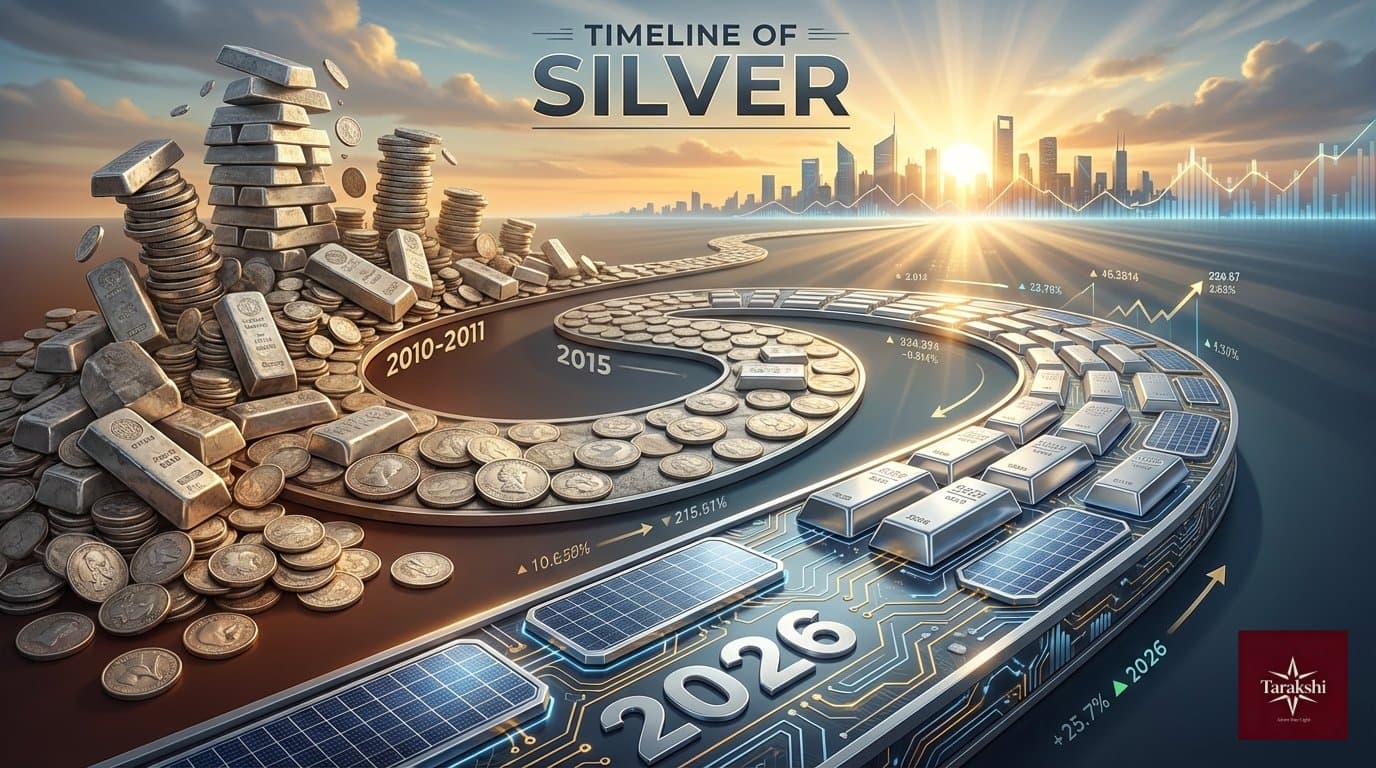
Silver Price History in India (2010–2026): What Changed in Each Cycle?
By Tarakshi Market Team
Why History Matters More Than Headlines
Understanding silver's 16-year price journey in India reveals that waiting for the "perfect" moment to buy often costs more than buying consistently during dips, because market timing is nearly impossible but time in the market always wins. To understand the numbers on our Live Silver Prices page today, we must look at the ghosts of 2011—and the record-breaking surge of January 2026.
I've been tracking the MCX silver ticker since 2010. I remember the panic calls from jewellers in 2013 asking if silver would ever recover. I watched customers hoard silver in 2020 thinking civilization was ending. And just last month, I witnessed silver shatter every record in existence, hitting ₹4,10,000 per kilogram before crashing 40% in three weeks.
The question everyone asks today: "Did I miss the top? Should I wait for another crash?" The answer, as always, depends on which lens you're using. Let me walk you through the four major cycles that defined silver's story in India—and what the explosive 2025-2026 rally teaches us.
The Silver Price Timeline: A Bird's Eye View
Between 2010 and February 2026, silver prices in India have ranged from a low of ₹34,000/kg to an all-time high of ₹4,10,000/kg, with the most dramatic move being a 170% surge in 2025 alone driven by industrial demand and speculative momentum. Here's the macro view:
| Year | Approx Price (₹/kg) | Major Event | Market Mood |
|---|---|---|---|
| 2011 | ₹73,600 | Previous All-time High (Speculation) | Euphoric Frenzy |
| 2013 | ₹52,000 | Post-Bubble Crash Begins | Panic & Denial |
| 2015 | ₹34,000 | Bear Market Bottom | Despair & Apathy |
| 2018 | ₹38,000 | The "Boring" Plateau | Indifference |
| 2020 Mar | ₹38,000 | COVID Crash Low | Fear |
| 2020 Aug | ₹65,000 | COVID Stimulus Rally | FOMO |
| 2023 | ₹78,600 | Inflation Hedge Peak | Cautious Optimism |
| 2024 | ₹95,700 | Industrial Demand Breakout | Rising Confidence |
| 2025 Nov | ₹1,50,500 | Parabolic Acceleration Begins | Euphoria |
| 2026 Jan 29 | ₹4,10,000 | All-Time High (Record) | Peak Frenzy |
| 2026 Feb 17 | ₹2,60,000 | Sharp Correction (-37%) | Fear & Confusion |
Each of these cycles had its own personality, its own fear and greed. Let's dive into what actually happened—and what it means for buyers navigating today's volatility.
Cycle 1 (2010–2012): The First Speculative Frenzy
Silver hit what was then an all-time high of ₹73,600/kg in April 2011 because global investors, spooked by the 2008 financial crisis and fearing currency collapse, piled into precious metals as a "doomsday hedge" driving speculative demand to unsustainable levels. This wasn't driven by jewellery demand or industrial use—it was pure financial speculation.
What the market felt like
I remember walking into Zaveri Bazaar in early 2011. The air was electric. Traders were glued to their phones, refreshing COMEX silver prices every 30 seconds. Retail investors who'd never touched commodities were opening trading accounts to buy silver futures. TV news anchors were breathlessly declaring, "Silver could hit $100 per ounce!"
In rupee terms:
- 2010: Silver averaged ₹42,000/kg
- Early 2011: Climbed to ₹55,000/kg
- April 2011: Spiked to ₹73,600/kg in a single week
- May 2011: Crashed 30% in 5 days
Customers who bought silver jewellery at the peak—thinking prices would keep climbing forever—watched the metal value of their purchase drop by a third within months. The speculation-driven rally collapsed as quickly as it had formed.
The lesson
When everyone from your taxi driver to your dentist is talking about buying silver as an "investment," you're probably near a top. Speculative bubbles always burst. Jewellery buyers should never chase parabolic price spikes.
Cycle 2 (2013–2019): The Long Winter
After the 2011 bubble burst, silver entered a brutal 6-year bear market where prices stagnated between ₹34,000 and ₹42,000/kg, with most years seeing flat or negative returns that crushed speculator sentiment but created the best buying opportunity of the decade. This was the era nobody talks about—because it was boring.
Why this was the "lost decade" for traders
From 2013 to 2019, silver did basically nothing:
- 2013: Crashed from ₹52,000 to ₹45,000 as speculators fled
- 2015: Hit the cycle low at ₹34,000/kg (the bottom)
- 2016-2019: Meandered sideways between ₹36,000 and ₹42,000
For traders and investors, this was torture. No exciting moves. No headlines. Just years of dead money. Many gave up entirely, declaring "silver is finished."
But for jewellery buyers? Paradise.
This was the single best window to buy silver jewellery in modern history. Why?
- Prices were stable and predictable
- No FOMO (fear of missing out) pressure
- Jewellers offered reasonable making charges because raw material wasn't volatile
- You could plan a wedding 6 months out and know the price wouldn't spike
The families who quietly bought their bridal sets, anniversary gifts, and heirloom pieces during 2015-2019 locked in prices that are now 6-8x lower than the January 2026 peak. They weren't trying to "time the market"—they just needed jewellery and bought it when it was reasonably priced.
The lesson
The best time to buy is often when nobody is talking about it. Boring markets favor buyers. Exciting markets favor sellers.
Cycle 3 (2020–2023): The Pandemic & Inflation Hedge
Silver surged from ₹38,000/kg in March 2020 to ₹78,600/kg by end of 2023 as governments printed trillions in stimulus money, creating inflation fears that drove investors back into precious metals as a store of value. This wasn't speculation like 2011—it was genuine macro fear.
The COVID shock (March-April 2020)
When India announced the first lockdown, panic hit the silver market:
- Week 1: Silver crashed from ₹47,000 to ₹38,000/kg as people liquidated assets for cash
- Week 3: Jewellery shops closed nationwide; MCX trading went haywire
- Month 2: Prices rebounded to ₹50,000/kg as stimulus news emerged
- By August 2020: Silver hit ₹65,000/kg—the fastest recovery in commodity history
The inflation era (2021-2023)
As inflation roared globally:
- 2021: Silver stabilized at ₹68,000-₹72,000/kg
- 2022: Russia-Ukraine war pushed it to ₹75,000/kg
- 2023: Ended the year at ₹78,600/kg as US inflation peaked
During this period, silver's narrative shifted. It was no longer a "speculative play"—it was a genuine inflation hedge. Families who'd kept cash idle saw their savings eroded by 6-8% annual inflation. Silver became a wealth preservation tool.
The lesson
Inflation-driven rallies are different from speculation bubbles. They're backed by real economic forces and tend to hold longer. Don't expect 2015 prices during an inflation crisis.
Cycle 4 (2024–2026): The Industrial Supercycle That Became a Mania
Silver prices exploded from ₹78,600/kg in January 2024 to a record ₹4,10,000/kg by January 29, 2026—a staggering 420% gain in 25 months—driven initially by industrial demand but ultimately fueled by speculative excess that led to a brutal 40% correction within three weeks. This is the most dramatic cycle in silver's modern history.
Phase 1: The Industrial Foundation (2024)
The 2024 rally started legitimately:
- Solar panel manufacturing: Each panel uses 20 grams of silver; India's solar installations tripled
- EV electronics: Silver is the best electrical conductor; EV adoption quintupled
- Supply deficit: Mine supply couldn't keep up with demand
Silver climbed from ₹78,600/kg to ₹95,700/kg (+22%) in 2024—a healthy, fundamental-driven move.
Phase 2: The Parabolic Blow-off (2025)
Then things got wild. Silver gained 170% in 2025 alone:
- August 2025: ₹1,13,000/kg
- September 2025: ₹1,51,000/kg (+34% in one month)
- November 2025: ₹1,50,500/kg (briefly stalled)
- December 2025: ₹2,39,000/kg (+59% in one month)
- January 2026: ₹3,50,000/kg by Jan 1, then ₹4,10,000/kg by Jan 29
This wasn't industrial demand anymore—this was pure mania. Retail investors piled in thinking "silver to ₹5 lakh!" Social media was flooded with "buy now or regret forever" posts.
Phase 3: The Correction (February 2026)
Then reality hit. Hard :
- Feb 1: ₹3,50,000/kg
- Feb 9: ₹3,00,000/kg
- Feb 13: ₹2,80,000/kg
- Feb 17: ₹2,60,000/kg (-37% from peak in 19 days)
People who bought silver jewellery at ₹4 lakh/kg in late January are now staring at 40% paper losses. The speculative fever broke as quickly as it formed.
What caused the crash?
Analysts point to :
- Profit-taking: Early buyers cashed out
- Margin calls: Leveraged traders forced to sell
- Stronger dollar: USD strength makes dollar-priced silver more expensive for Indians
- Speculative exhaustion: The "buy silver" trade got too crowded
The current market mood (Feb 17, 2026)
Unlike the slow grind of 2013-2019, today's market is shell-shocked. On our Live Silver Prices page, you can see daily swings of ₹15,000-30,000/kg—volatility that makes planning jewellery purchases nearly impossible.
The big question: Is this a healthy correction in a bull market, or the start of a 2011-style multi-year collapse?
The buying strategy for February 2026
If you're planning jewellery purchases right now:
- Don't try to catch the exact bottom: Prices could drop to ₹2 lakh or bounce to ₹3 lakh—nobody knows
- Do wait for stabilization: When prices trade in a tight range for 2-3 weeks, that's your signal
- Prioritize flexibility: If you can delay purchases by 2-3 months, do it. Let the dust settle.
- Set price alerts: Use the Live Price Page to track when prices hit your target range
The lesson
Parabolic rallies that gain 400% in 2 years always—always—give back a significant portion. The 2011 peak took 15 years to exceed. This cycle's survivors will be those who bought during the boring years (2024) and sold into the mania (late 2025), not those who FOMOed at ₹4 lakh.
What About the Next Move?
While silver has corrected sharply from ₹4.1 lakh to ₹2.6 lakh, whether it stabilizes here or falls further to ₹2 lakh or ₹1.5 lakh depends on whether industrial demand provides a floor or if speculative selling continues to dominate. Let me be honest: I don't know where the bottom is.
What I do know:
- If you're buying for a wedding in 2-3 months: Wait another 4-6 weeks for volatility to calm. The current 10-15% daily swings make planning impossible.
- If you bought at ₹4 lakh in January: Don't panic-sell at ₹2.6 lakh. If you bought for wearing (not trading), the jewellery's value to you hasn't changed.
- If you're waiting for ₹1.5 lakh: That might happen, or it might not. Set a reasonable target (say ₹2.2-2.4 lakh) and act when it hits.
The families who skipped buying in 2016-2019 waiting for ₹30,000/kg are now facing ₹2.6 lakh/kg. Opportunity cost is brutal.
The Psychological Traps Every Cycle Repeats
Human psychology creates predictable patterns in every commodity cycle: greed at tops, fear at bottoms, and regret during the climb back up. Here's what I've observed:
At market tops (like April 2011, January 2026):
- Everyone wants to buy
- "Prices will only go up!"
- Social media echo chambers amplify FOMO
- Jewellers can barely keep inventory
During the crash (like May 2011, February 2026):
- Panic selling dominates
- "Silver is going to zero!"
- Buyers vanish overnight
- Regret and blame fill the conversation
At market bottoms (like 2015, March 2020):
- Nobody wants to buy
- "Silver is dead, buy crypto/stocks instead"
- Jewellers offer discounts because footfall is low
- Media ignores silver entirely
During the recovery:
- Early buyers feel smart
- Late buyers feel regret
- Non-buyers rationalize: "I'm waiting for the next dip"
The trick is recognizing which phase we're in—and acting counter to the crowd's emotion.
The Bottom Line: Don't Wait for Perfection
Looking at 16 years of price history, the buyers who did best weren't the ones who perfectly timed the 2015 bottom—they were the ones who bought consistently during quiet periods (2015-2019, 2024) and avoided panic-buying during manias (2011, January 2026). History doesn't repeat exactly, but it rhymes.
The ₹4,10,000/kg peak of January 2026 shattered the previous 2011 record by 450%. The ₹34,000/kg bottom of 2015 will likely never be seen again. If you're waiting for 2015 prices in 2026, you're waiting for a world that no longer exists.
But equally, if you're wondering "Did I miss it?" after the recent crash—the answer is maybe not. Silver has corrected 40% in three weeks. If industrial demand fundamentals hold, this could be your 2020-style buying opportunity.
Watch the current cycle unfold on our Real-Time Chart. Set reasonable expectations. Buy when prices stabilize, not when they're in free-fall. Prioritize the jewellery you need for life events over the jewellery you're hoarding as a speculation.
And remember: your grandmother's silver jewellery from the 1980s is still beautiful, still wearable, and still valuable—regardless of what silver traded at in any given month. That's the real lesson of history.
Buy quality. Buy thoughtfully. But don't let the fear of "bad timing" paralyze you forever. February 2026's ₹2.6 lakh might look cheap in 2030—or expensive in 2028. Nobody knows. But the jewellery you wear to your daughter's wedding will be priceless regardless.
Frequently Asked Questions
What was the highest silver price in India ever?
Silver hit an all-time record of ₹4,10,000 per kilogram on January 29, 2026 on MCX before correcting 40% to ₹2.6 lakh by mid-February.
When was the best time to buy silver in India?
The best buying window was 2015-2019 when prices stagnated at ₹34,000-42,000/kg, offering stable, low prices with minimal volatility for years.
Will silver crash again like 2011 and 2026?
History shows speculative bubbles always correct. Silver crashed 30% in 2011 and 40% in 2026 after parabolic rallies. Future crashes depend on speculation levels.
Is silver overpriced in February 2026?
At ₹2.6 lakh/kg after a 40% crash, silver is cheaper than January's peak but still 230% above 2024 levels. Wait for stabilization before buying.