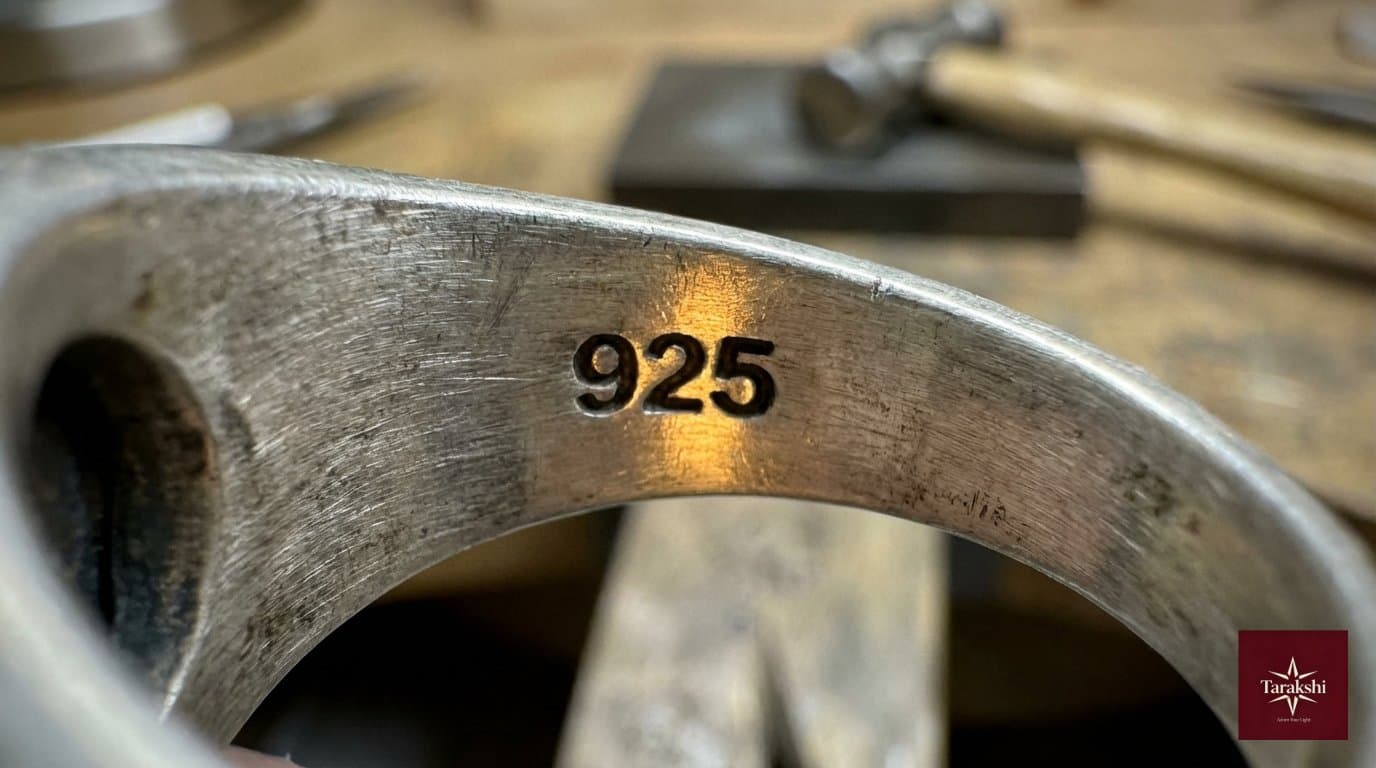
What Does '925' Actually Mean? (And Why It Matters)
By Tarakshi Editorial Team
The Surprising Truth About "Pure" Silver
Here's something that shocks most jewelry buyers: 100% pure silver is actually terrible for making jewelry because it's so soft it bends like butter and can't hold its shape. After two decades of forging silver in our workshop, I've watched countless apprentices learn this lesson the hard way—trying to hammer a clasp from fine silver only to have it deform under the pressure of a simple finger pinch.
That tiny "925" stamp you see on quality silver jewelry isn't a compromise—it's an engineering breakthrough that's been perfected over centuries. It represents the exact formula that gives silver both its lustrous beauty and the structural integrity to last generations.
What Does 925 Actually Mean?
The number 925 means your jewelry is made of 92.5% pure silver mixed with 7.5% other metals (usually copper), creating what's globally known as Sterling Silver. Think of it like a recipe: for every 1000 parts of metal, 925 parts are pure silver and 75 parts are strengthening alloys.
In mathematical terms:
- 92.5% = Pure Silver (the precious metal content)
- 7.5% = Copper or other alloys (for durability)
- Total = 100% of the metal in your jewelry
This ratio isn't arbitrary—it's the result of centuries of metallurgical experimentation to find the perfect balance between purity and practicality.
Why Not Use 100% Pure Silver?
Pure silver (also called Fine Silver or .999 silver) is butter-soft and bends easily between your fingers, making it completely unsuitable for functional jewelry like clasps, hooks, or thin chains. In our Tarakshi workshop, we keep a small bar of fine silver specifically to show customers what we mean.
When you press your thumbnail into pure silver, it leaves a permanent dent. Imagine that softness in:
- Earring hooks that need to hold their curved shape through thousands of insertions
- Ring bands that must resist the constant pressure of daily wear
- Chain links that would pull apart under the weight of a pendant
- Jhumka bells with intricate cutwork that would collapse
I've personally watched a fine silver wire ring deform into an oval after just three days of wear. The metal simply can't maintain tension or structural integrity without the addition of hardening alloys.
The Secret Ingredient: Why Copper?
Copper is added to pure silver because it dramatically increases hardness and durability without significantly changing silver's color or tarnish-resistance properties. The 7.5% copper content transforms soft silver into a metal that can:
- Hold intricate engravings and textures
- Maintain spring tension in clasps and ear wires
- Resist scratches from daily wear
- Support gemstone settings without prongs bending
The Trade-Off
Copper does make sterling silver more prone to tarnishing (that dark patina you see over time) compared to pure silver. However, this is easily reversible with polishing and actually proves your piece is genuine—fake jewelry doesn't tarnish the same way.
Other Silver Purity Standards (Why 925 Wins)
While other silver ratios exist, 925 Sterling Silver is the global standard because it offers the optimal balance of workability, durability, and value. Here's how it compares:
| Purity Grade | Silver Content | Best For |
|---|---|---|
| Fine Silver (.999) | 99.9% pure | Bullion bars, coins, investment |
| Sterling Silver (925) | 92.5% pure | Jewelry, heirlooms, daily wear |
| Britannia Silver (958) | 95.8% pure | Decorative pieces, rare European jewelry |
| Coin Silver (900) | 90% pure | Vintage pieces, historical jewelry |
Britannia silver (.958) is slightly purer and offers a brighter finish, but it is rarely used in modern jewelry because it is significantly softer than Sterling. Most jewelers prefer Sterling Silver (.925), which provides superior durability for daily wear while costing less than its purer counterpart.
How to Find the 925 Stamp on Your Jewelry
The 925 mark is legally required on all sterling silver sold in India and must be stamped in an inconspicuous location that doesn't damage the design. Grab a magnifying glass or your phone's macro camera and check these spots:
Where to Look:
- Rings: Inside the band (opposite the decorative front)
- Bangles/Bracelets: Near the clasp or on the inner surface
- Necklaces: On the clasp mechanism or a small tag near it
- Earrings: On the back of studs or the base of hooks
- Anklets: On the clasp or a connecting ring
What You'll See:
Authentic Tarakshi pieces carry multiple marks:
- 925 or 92.5 (purity guarantee)
- BIS Hallmark with a triangle (Indian certification)
- Tarakshi maker's mark (our quality signature)
- Assay center code (the testing lab that verified purity)
If you see "Silver Plated," "German Silver," or no stamp at all, it's not sterling silver.
Why 925 is the Heirloom Standard
Sterling silver jewelry has remained chemically stable and wearable for over 4,000 years of human history, making it one of the few materials guaranteed to outlive you. Archaeological digs routinely uncover Roman and Egyptian silver jewelry that, after cleaning, looks nearly identical to modern pieces.
This longevity comes from the 925 formula's unique properties:
- Chemical stability: Won't corrode or rust (only tarnishes superficially)
- Repairability: Silversmiths can resize, solder, and restore 925 pieces indefinitely
- Hypoallergenic: Pure enough that most people with metal sensitivities can wear it
- Value retention: Holds intrinsic precious metal value
In our restoration workshop, we've successfully repaired 925 silver pieces from the 1800s. Try doing that with fashion jewelry.
The Certification You Can Trust
In India, the Bureau of Indian Standards (BIS) mandates that all sterling silver jewelry must be hallmarked by government-approved assaying centers before sale. This isn't just a stamp—it's a legally enforced promise.
The BIS hallmarking process:
- Manufacturer submits jewelry to an independent testing lab
- Lab conducts X-ray fluorescence (XRF) testing to verify exact silver content
- Pieces meeting 92.5% purity receive the official stamp
- Any deviation results in rejection and potential legal penalties
When you buy hallmarked 925 silver, you're not trusting the seller—you're trusting a government-verified scientific measurement.
Does Higher Purity Mean Better Quality?
No—higher purity often means worse jewelry because metals above 925 purity are too soft for practical wear and offer no visual or functional advantages. This is the biggest misconception we encounter.
Think of it like gold: 24K gold (100% pure) is investment-grade but terrible for rings because it scratches if you look at it wrong. That's why engagement rings use 18K or 14K gold—durability matters more than absolute purity when the item needs to survive decades of daily wear.
The same logic applies to silver. 925 Sterling is the jewelry industry's answer to "What's the purest silver we can use while still making pieces that don't bend in your jewelry box?"
The Bottom Line
The 925 stamp represents 600 years of metallurgical wisdom compressed into three digits—it's the precise recipe that transforms soft, pure silver into heirloom-quality jewelry. It's not a marketing term or a compromise; it's the global standard because nothing works better.
When you see that tiny stamp on a Tarakshi piece, you're seeing a promise: this jewelry is 92.5% precious silver, hard enough to last generations, and certified to a standard that's survived centuries of use. That's why every piece of quality silver jewelry in the world—from Tiffany to Tarakshi—uses this exact formula.
Demand the 925 mark. Accept nothing less. And know that you're wearing the same precious metal purity that adorned queens, survived wars, and will outlive you.
Frequently Asked Questions
Is 925 silver real silver?
Yes, 925 silver (Sterling Silver) is real silver containing 92.5% pure silver and 7.5% alloy metals, making it the global standard for quality jewelry.
Does 925 silver tarnish?
Yes, 925 silver naturally tarnishes due to its copper content reacting with air and sulfur. This is normal, reversible with polishing, and proves authenticity.
Is 925 silver good for daily wear?
Yes, 925 sterling silver is specifically designed for daily wear. The 7.5% copper alloy provides durability and scratch resistance that pure silver lacks.
What is the 7.5% alloy in 925 silver?
The 7.5% is typically copper, added to strengthen pure silver and make it hard enough for jewelry. Some manufacturers use zinc or nickel instead.
Why is pure silver not used for jewelry?
Pure silver (99.9%) is too soft—it bends easily, can't hold intricate shapes, and deforms with normal wear, making it unsuitable for functional jewelry.